Why Job Search Analysis Reveals Your Hidden Logistics Crisis
 Angela Roberts

Job analysis uncovers why life logistics (childcare, money, commute) tank your search. Align them first via the Compass for real bandwidth.
On the surface, Angela’s search was finally starting to move.
Her skills were dialed in, her portfolio had some real shine, and her outreach was landing in the right inboxes. She even messaged me one afternoon: “Okay…things are actually clicking.”
And then life, as it tends to do, stepped right in the middle of that progress.
It was 6:47 p.m. Dinner was cooling on the table, her child was tugging at her sleeve for homework help, and her phone buzzed with a recruiter asking for a “quick 30‑minute call”...as in, right now.
Angela froze.
“I can’t,” she said. “We have pickleball with my husband’s coworkers. Non‑negotiable.”
She hung up, looked at the congealing chicken, glanced at the homework spread across the table, and sighed, “Why does this feel so impossible?”
That moment is what low job search well‑being really looks like.
Not a dramatic breakdown, but a constant, exhausting tug‑of‑war between your search and your actual life until everything starts to feel heavy. A good job search analysis will show you are moving to a breakdown long before you hit full burnout.
From a coaching perspective, that is the exact moment to pause and zoom out.
So we pulled up her Job Search Strategy Compass and took an honest look. Her Life & Logistics Fit score? A painful 3 out of 10. The rest of her categories sat in the “decent” 6s and 7s range... not perfect, but functional. Life & Logistics, however, was dragging the entire map inward, turning what could have been strong job search momentum into a deflated, lopsided shape.
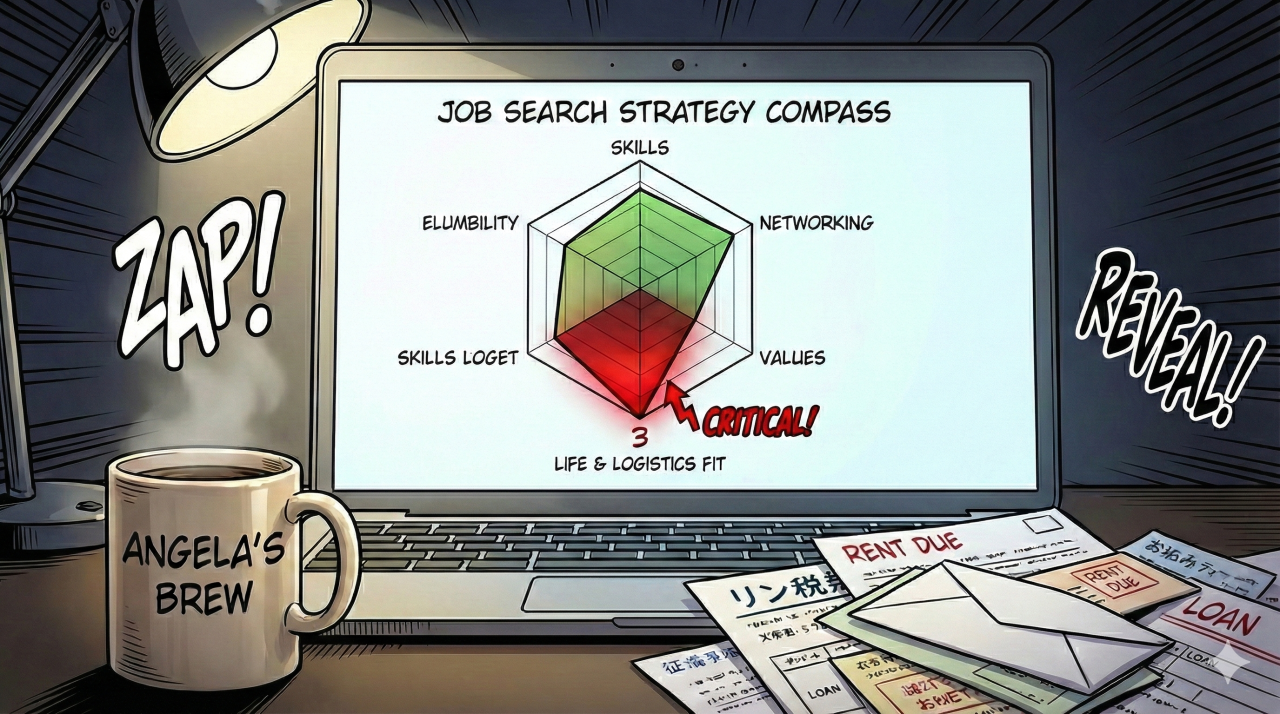
Those diagnostic questions do not play around:
- How well does my search align with my financial realities, caregiving responsibilities, commute, schedule, and other life constraints?
- Am I being realistic about my life while still respecting my priorities and goals?
Her Compass made one thing clear: the problem was not effort. It was how her job search approach fit into her life and logistics. And this is exactly why job search analysis matters. Because without it, you end up blaming motivation when logistics are the real culprit.
When Life & Logistics is out of alignment, your patterns start telling on you.
You begin playing calendar gymnastics every week, trying to squeeze interviews into childcare gaps that do not exist. Recruiters want to talk right when you are in pickup lines, helping with homework, or trying to keep your partner’s schedule afloat. Networking events always seem to land on the nights you are already stretched thin.
So you cram applications into 11 p.m. bursts after a long day. You are tired, the house is noisy, and typos sneak in. It feels like you are working on your search constantly, but your results look like a half-hearted effort.
That is not a character flaw.
That is logistics calling the shots.
Money plays its part too. Your bridge job pays the basics but leaves no flex for unpaid time off to meet with hiring managers. Gas for coffee chats becomes a real issue. One unexpected expense, like a car repair or medical bill, forces you to pull back on networking or skip interview days altogether.
Suddenly, your “I’m just one conversation away” optimism turns into “I’m one crisis away from putting this whole thing on pause.”
Location quietly weighs in as well. The roles you are excited about sit downtown, while you are in the suburbs, juggling a 45‑minute commute and no direct transit. Hybrid postings require two days a week onsite, and you tell yourself that you will “figure it out later,” but deep down, you know it is a strain. Without intentional job search analysis, it is easy to call that “logistics” on the surface while quietly avoiding roles you actually want.
And then there is energy.
When you do not have dedicated search time, you start borrowing it from everywhere else: sleep, mealtimes, family connection... the tiny slivers of rest you had left. You are updating LinkedIn from the carpool line, tinkering with your resume between loads of laundry, answering messages while half‑paying attention to your kid’s soccer game.
You feel “busy,” but you do not feel effective. Burnout starts to look like “this is just my life now” instead of what it really is: a system that needs adjusting.
This is where Angela’s work with the Job Search Strategy Compass changed the game.
Seeing that Life & Logistics Fit score at a 3 was not an indictment of her commitment. It was a signal: the strategy she was using did not match the life she was actually living. Once she saw it on the Compass, she could not ignore it. And from a coach’s perspective, that insight is gold. When you shore up that one area, the rest of the map suddenly has room to expand.
Her action steps were not flashy. They were simple, specific, and grounded in reality:
- She carved out a protected 7:00–8:00 p.m. window for job search tasks after dinner, before bedtime chaos. Everyone in the house knew that was her focused hour.
- She filtered roles more intentionally, prioritizing positions that offered flexible hours and truly optional hybrid arrangements instead of forcing herself into configurations that would drain her long‑term.
- She set aside a $200 “job search fund” by cutting back on small extras. That little cushion covered gas, parking, and coffee chats without triggering financial stress every time an interview popped up.

Within a week, the tone shifted. Recruiters were more than willing to schedule calls within her available window once she clearly communicated it. Her energy felt steadier. Her child got focused homework attention instead of half‑distracted help while she checked email under the table. Her Life & Logistics Fit score did not shoot to a 10 overnight, but it moved. And that movement supported everything else.
Job search well‑being isn't a luxury item. It is the foundation of everything else you do. When your logistics are aligned, you create bandwidth for better applications, better conversations, better interviews, and a more sustainable pace. A thoughtful job search analysis will show you that your calendar, your responsibilities, and your energy are part of the strategy, not side issues to “fix later.”
Low scores do not lie. When your Compass shows Life & Logistics waving the white flag, it isn't saying, “You are failing.” It is saying, “Your current approach is not built for your real life.”
Listen to that. Because once you let your job search analysis guide you there, you stop trying to outwork your circumstances and start designing a search that actually fits.
Categories: : Job Search Best Practices