Owning the Narrative: How to Talk About Your Layoff Without Sounding Like a Victim
 Angela Roberts
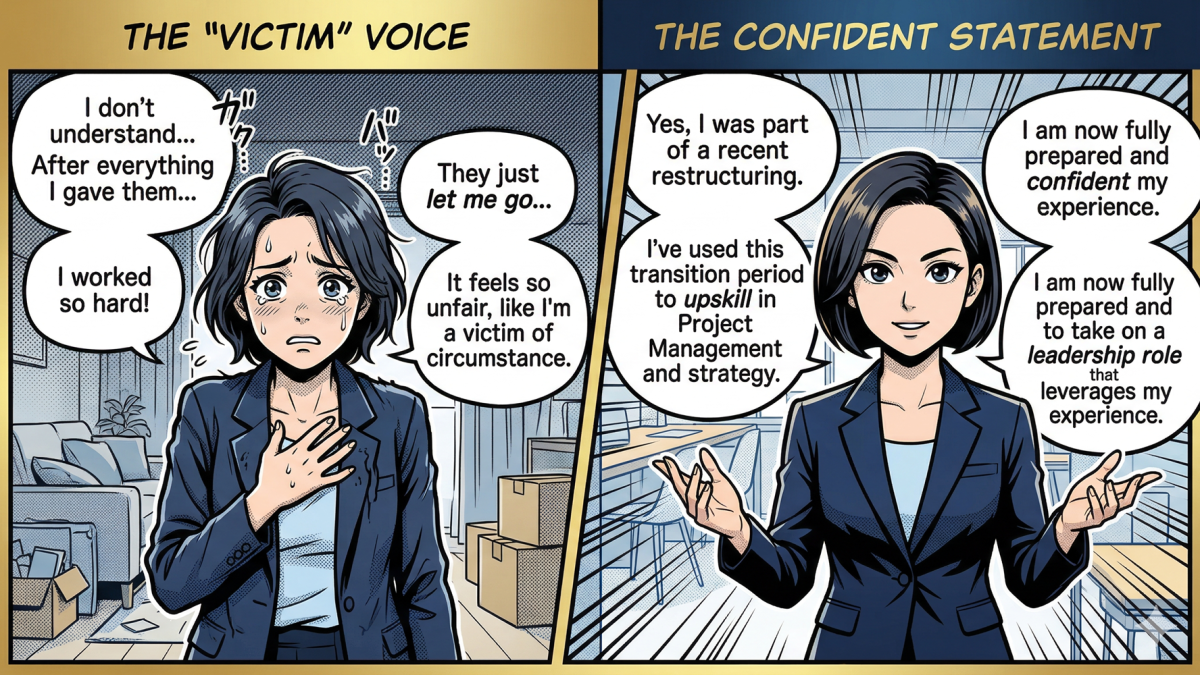
Stop sounding like a victim after a layoff. Master your exit statement and explain resume gaps with total confidence today!
“So, what happened at [Company Name]?”
For a mid-career professional, that is the single most dreaded question in the modern job market. Whether it’s asked by a well-meaning former colleague over coffee or a recruiter in a high-stakes screening call, it can feel like an accusation. Your heart races, your palms sweat, and suddenly, 15 years of leadership success are eclipsed by a single afternoon in a severance meeting.
If you are currently navigating mid-career unemployment, the biggest hurdle isn't your lack of skills. It is shedding the "Layoff Scent." This is the subtle air of defensiveness or bitterness that leaks into your conversations when you haven't yet mastered your layoff exit statement.
To find your footing, you have to move from being a "victim of a restructuring" to being the "architect of a transition." Here is how you own the story of your career setback.
1. The Power of the Neutral "Exit Statement."
The biggest mistake you can make is over-explaining. When you give a five-minute play-by-play of the company’s internal politics, you sound like a liability. Instead, you need a simple (and emotion-free) layoff exit statement that is short, factual, and forward-looking.
The Script:
"The company underwent a strategic restructuring that impacted 15% of the workforce, including my department. While I am disappointed to leave a team I am proud of, I am grateful for the [Specific Achievement] I led. And, I am now focused on bringing my expertise in [Skill A] to a new challenge."
Why it works:
It acknowledges the event as a business decision (not a personal one), highlights your value, and immediately pivots to the future.
2. Explaining a Resume Gap in Today's Market
Ten years ago, a three-month gap was a scarlet letter. In today's market, it is a data point. With the "Job Hugging" trend making hires slower and more deliberate, recruiters expect to see gaps.
The trick to explaining a resume gap isn't to hide it, but to "fill" it with professional resilience. In other words, instead of saying you were "looking for work," talk about what you were doing to improve your professional skills:
- "I have been using this transition to consult for two startups in the [Industry] space."
- "I have been deep-diving into AI-driven operations to ensure my next leadership role leverages modern tech stacks."
When you show that you are an "Active Asset," the gap becomes a period of strategic growth, not a period of waiting.
3. Shift from "What Happened to Me" to "What I Solve."
A career transition support strategy that actually works is one that focuses on utility. If you lead with the layoff, you are selling your history. If you lead with your ability to solve a specific problem for the new company, you are selling your future.
Remember: You aren't "unemployed." You are a senior professional whose current contract has ended and whose next partnership is being carefully selected.
Don’t Navigate the "Void" Alone.
Mastering your narrative is the difference between a "rebound" job and a career upgrade. If you are tired of the "black hole" of online applications and ready to take control of your professional story, let's get to work.
Join the Masterclass:
In my upcoming Live Webinar, The Layoff Reset, I will be doing live "Exit Statement" audits. We will take your specific situation and "re-code" it into a narrative of high-authority leadership.
Categories: : Job Search Best Practices, Personal Branding