Is Your Resume Summary Selling the Job You Want to Leave?
 Angela Roberts
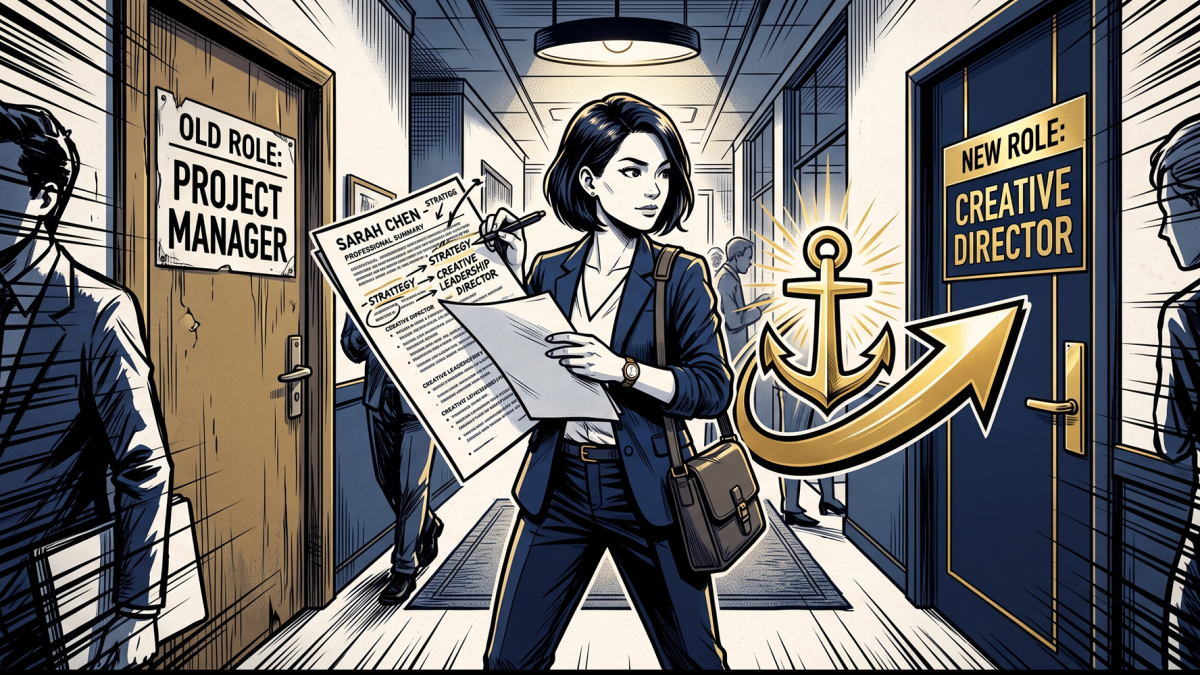
Pivoting to a new field? Your resume summary may sell the wrong job. Learn to target the role you want with proof that you fit it.
This was our fifth coaching session, and Amy still hadn't finalized her resume.
I really liked Amy. She had more than two decades of experience in clinical research as a data manager. Her soft skills were excellent, and it was clear she was very good at her job. But she wanted a change... she wanted to pivot into a CRA role.
From where I sat, I could see exactly how her twenty-plus years in data management would appeal to a hiring manager looking for CRAs. And the reality is that she knew she could do the job. After all, she had the base knowledge, technical and soft. She definitely had the drive. So what, exactly, was holding her back?
In a nutshell, her resume was holding her back.
She had been applying with the same resume she used as a data manager. It had served her well, so of course she reached for it. But that resume was a history of her past, and the silence that followed every application proved that version of her resume wasn't working.
She knew she needed to update her resume to reflect her new career trajectory. But her challenge was how to spell out her ability to gracefully shift into a different function, with different day-to-day demands and a different kind of challenge. It just felt like too much to explain on paper.
She couldn't figure out how to tell the story of where she was going.
What Amy couldn't see
What was holding Amy back lived in the top third of her resume: her professional summary and the few lines at the very top, the first thing anyone reads. Hers still described a data manager, in the language data managers use.
So when a hiring manager looking for CRAs read her resume summary, they didn't see a CRA. They saw someone from a different function, and in about six seconds they moved on, even though her skills would transfer beautifully. The gap was never her ability. The gap was that she hadn't translated her capabilities into the language of the role she wanted.
What a summary is really for
Here is what Amy came to understand. A resume summary isn't a title badge. And it certainly doesn't serve in the place of the old-fashioned Objective. It is the place where you tell the reader what you are capable of, regardless of the title you have held or the function you held it in.
It is where your transferable skills live. The soft skills that travel everywhere: leading, managing competing priorities, keeping demanding stakeholders aligned. And the hard skills that transfer further than most people expect. In Amy's case, this was wrapped in twenty years of protecting data quality, catching discrepancies, and holding studies to protocol... all of which a CRA does too. The CRA just does it at the site instead of in the database.
Amy's First Step: A comparative analysis
The first step was to analyze what hard/technical skills and soft/transferrable skills overlap across the two positions. We pulled data from about a dozen current job descriptions across industry sources for both roles and found the overlap wasn't incidental (as we suspected). And while I will spare you the boring details, it was clear that while these were two different roles, they have one shared responsibility...only split by the physical vantage point.
Why was this exercise important?
Where the two roles overlap, they share the same language. And when it comes to showing your qualifications for a target position, the language you use matters.
How Amy worked through it
Here are the two steps she took to got her unstuck.
First, she rewrote her resume summary for the role she wanted, not the one she had.
We pulled a real CRA posting and read the language it used: the title, the priorities, the skills the position required.
Then, using the overlap language from the previous exercise, she rewrote her summary to target the new position (instead of writing to a general audience).
Her summary became rich in the language outlining her skills that translated to the CRA role. For example, a focus on GCP/ICH and FDA regulatory fluency, protocol comprehension, her EDC system experience, a couple of strong mini-stories on query generation and resolution, and her experience with case report form design and structure. She then addressed the soft skills, writing mini-stories that showed her attention to detail, communication (written and verbal), diplomacy and influence without authority, problem-solving under regulatory constraint, and emotional intelligence and empathy.
Second, she translated one real result into CRA language.
As a data manager, she would have written something like "Managed clinical trial databases and ensured data integrity across Phase III studies." This was true, but it spoke to the old role. We rephrased the result for the new position, and it became "Two decades keeping Phase III data clean and audit-ready, catching the discrepancies and protocol deviations at the data level that a CRA is trained to catch at the site."
Same accomplishment. Nothing has been made up or embellished. The difference? Now a CRA hiring manager could see the fit.
That was the moment it clicked for her. She wasn't starting over. She was finally telling the story of where she was going.
Your turn
Your pivot has an Amy moment in it too, and you don't need to rebuild the whole resume to reach it. You only need to change two things.
Rewrite the opening line of your summary so it names the role you are moving toward. In terms of a CDM to CRA move, here is an example:
➤ I have spent [X] years on the data side of clinical trials, cleaning what monitors verified, writing the queries and specifications that shape monitoring visits, and reconciling what site staff entered. I know GCP, ICH, and FDA requirements. I know EDC systems from the design side. I know CRF structure because I built the forms. Moving to the CRA seat isn't a career pivot from scratch. It is the same protection of data integrity, done from the site instead of from the database. The training curve is shorter, and the depth I bring on the data side is depth most CRAs do not have.
Then take one accomplishment and restate it in the language of that role. Read it back, and notice how much more you sound like someone who already belongs there. Herer was Amy's first rewritten accomplishment:
➤ Managed clinical trial databases and ensured data integrity across Phase III studies, became
➤ Two decades keeping Phase III data clean and audit-ready, catching the discrepancies and protocol deviations at the data level that a CRA is trained to catch at the site.
A pivot isn't starting over, and it isn't asking anyone to take a chance on you. It is showing, right at the top of the page, that the capabilities you have built in your previous role will travel with you. When you want help making that case clearly, the way Amy and I did together, that is exactly the work I do with people every day. Reach out any time.
Categories: : career development, Job Search Best Practices, Resume