How to Track Your Wins All Year Long: The Friday 15
 Savannah York
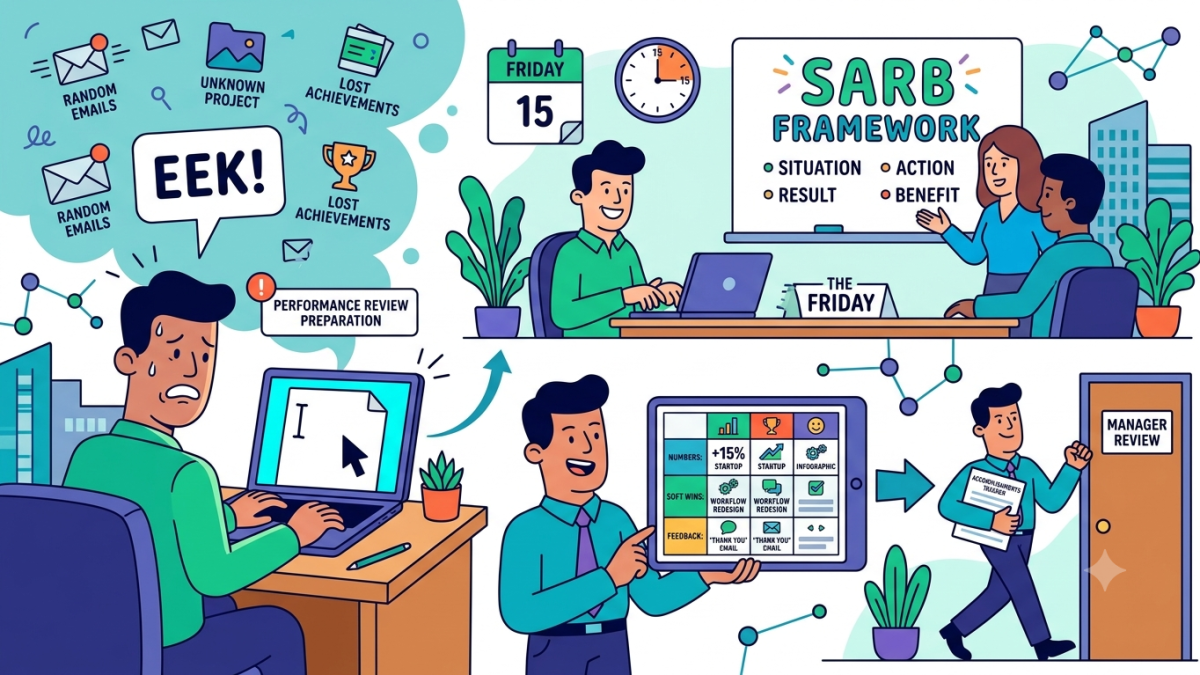
Track your wins all year so your next Performance Review feels clear, confident, and easy.
Tracking Your Progress with The Friday 15
Your manager sends a message on a random Tuesday afternoon. The subject line says, “Performance Review Preparation.”
Yikes. She wants a list of your biggest accomplishments from the past year.
You open a blank document and get ready to make a strong case for yourself. Then, about thirty seconds later, that confidence disappears and the cursor just keeps blinking back at you.
Now you are sitting there, trying to replay months of work in your head and remember the last time you did something that felt truly review worthy. Your mind keeps tossing out thoughts like, “I answered a lot of emails,” or “I supported that major project, but what was it again?”
Sound familiar?
The issue is not that you lack achievements. The real problem is that busy schedules, shifting priorities, and a never ending list of tasks bury the good work you have already done.
Most professionals spend so much time solving problems that they rarely stop long enough to notice their wins. Before they know it, they move on to the next challenge, and the strongest parts of their professional story disappear before they ever write them down.
Performance Review Preparation all year long
Here is what usually happens. You finish a big project, the team celebrates on Friday, and by Monday morning a new issue demands attention. Without thinking about it, you have already moved on.
A few weeks pass. Maybe a few months. The details of that win start to fade. The numbers, the outcomes, and even the kind messages from happy clients get lost in the crowd of emails and meeting notes.
That is the real challenge. If you do not capture those moments, they fade from your professional memory. Then, when you need to speak up for a promotion, a raise, or a new role, you end up trying to rebuild your accomplishments from scattered pieces of evidence.
Your goal should be to walk into every Performance Review knowing exactly what you contributed, how your work helped the team or company, and which problems you solved. You cannot do that if your accomplishments sit buried under old Slack messages and endless task lists.
Even top performers forget how much they actually impact their teams. We tend to keep moving forward instead of looking back. We finish the work, check the box, and focus on the next urgent task.
Without a record, those wins that show your growth, leadership, and problem solving skills vanish.
The Friday 15
Here is the shift that changes everything: I call it the Friday 15.
It is simple, and it works. Set aside fifteen minutes every Friday and write down what you accomplished that week.
You do not need to write a long report. You only need a few bullet points that capture the highlight and the impact.
A simple spreadsheet or table works well for this. When possible, I like to use the SARB framework.
SARB stands for:
- Situation: What was happening, or what problem needed attention?
- Action: What did you do to address it?
- Result: What happened because of your action?
- Benefit: Why did it matter to the team, client, or company?
That last part matters most. A lot of people stop at the result, but the benefit shows the real impact. Did your work save time, improve efficiency, reduce turnover, or strengthen a client relationship? That is the information decision makers care about most.
Fifteen minutes may not sound like much, but this habit changes how you see your work. You stop treating your accomplishments like random lucky breaks and start seeing them as proof of your influence.
It also removes the stress from Performance Review season. When your manager asks what you achieved this year, you do not scramble to remember everything. You open your tracker, and the story is already there.
What to track
Not every item in your tracker will be headline worthy, and that is completely fine. You want to record both the measurable wins and the people centered moments that keep work moving in the right direction.
Here is what to include in your Friday 15 tracker:
Numbers.
Start with the measurable outcomes. Maybe you improved study startup timelines by 15 percent, reduced vendor costs, increased site engagement, or saved the company $250K in resources. Numbers make your work concrete, so include specifics whenever you can.
Soft wins.
Some accomplishments do not show up on a dashboard. Maybe you resolved a conflict between two team members, trained a new hire who is now thriving, or improved a workflow that made everyone else’s job easier. Those moments often reveal your leadership in a deeper way.
Feedback.
Save the thank you emails, compliments, and shoutouts from clients and supervisors. Copy them into your tracker with the date. Those notes become powerful evidence when you need to show teamwork, influence, and results under pressure.
One more tip: do not worry about making the tracker perfect. This is not about grammar or design. It is about capturing your story while the details still feel fresh.
You can always polish the notes later when you turn them into a resume bullet, a LinkedIn update, or a Performance Review summary. The important part is to collect the raw material now.
What happens next
This habit changes the way you view your career.
Instead of feeling like you only react to problems, you begin to see how much you actually drive results. Every week, you build a record of value.
So the next time your manager asks for your accomplishments, you do not panic because you have handled Performance Review preparation all year. You open your Friday 15 tracker, choose your strongest examples, and organize them around the goals that matter most to your organization.
Even better, you stop waiting for Performance Reviews to remind you of your worth. You start noticing your strengths, your patterns, and your growth every week. That awareness builds confidence, and confidence helps you step forward when new opportunities appear.
When you track your accomplishments consistently, you stop searching for a job or promotion. You start selecting your next opportunity.
That shift, from searching to selecting, makes all the difference. It means you are no longer hoping someone notices your value. You already know it.
So this Friday, set aside fifteen minutes on your calendar. Make your coffee, open your tracker, and add three quick notes about what you achieved this week.
Because the truth is simple. No one else will keep that record for you. If you wait until your next Performance Review to remember your brilliance, the best parts of your story may already be gone.
Because the truth is simple. No one else will keep that record for you. If you wait until your next Performance Review to remember your brilliance, the best parts of your story may already be gone.
Categories: : career development, Mindset