Career Storytelling: From Nervous to Hired
 Angela Roberts
Master career storytelling to turn interview interrogations into business chats. Learn SARB stories, pocket tales, and smart questions to win the job.
Interviews Aren't Supposed to be Interrogations
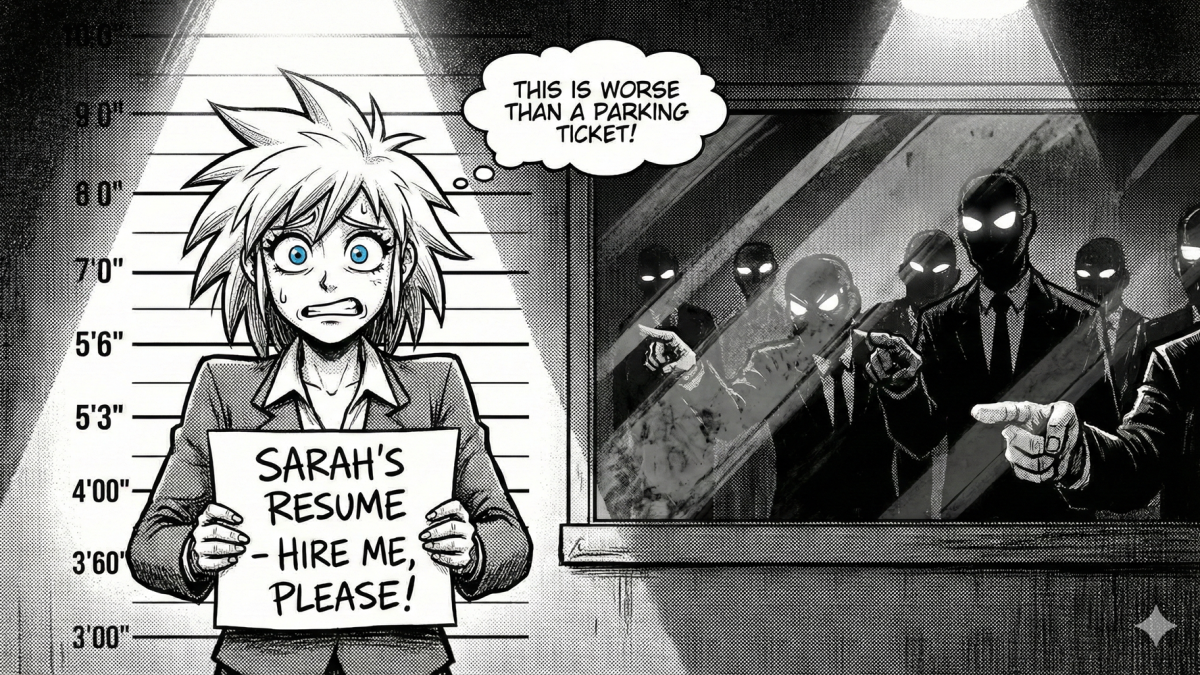
Going for an interview shouldn't feel like you are stepping into a police lineup.
Let me tell you about Sarah, a sharp project manager I recently coached. She called me in a panic, palms already sweating just thinking about it. “Angela, I’ve got this VP role at a tech firm, but every mock interview feels like I’m dodging bullets. Scripted answers, that sinking gut twist...I feel they are just waiting for me to flop.”
Here is the reality check I gave her: Hiring managers want to hire you. They need you. An interview isn’t an interrogation. It is a business meeting to hash out:
- Their problem: which just happens to be that open role you applied to, and
- Your solution: you stepping into that role.
Sarah shifted her mindset from suspect to consultant, and career storytelling flipped the whole script for her.
Having walked job seekers like Sarah through hundreds of these high-stakes moments, I have seen the interrogation trap snag even the sharpest professionals.
Sarah was rattling off her resume like a robot. So, of course, hiring managers were yawning through it. The fix? Telling stories that stick, showing you solve their exact pain points.
We broke down how to do this step-by-step, and her next interview felt like a real conversation. Here is how we did it.
The "Interrogation" Trap
Sarah treated her first practice run like a grilling under bright lights. She was dodging behavioral questions, hoping not to crack. But not sharing real stories kills the connection with your interviewer. And building a connection is everything.
Hiring managers aren’t cops. But they are swamped leaders hunting for someone to fix their mess: missed deadlines, team gaps, and revenue dips. Sarah had a lightbulb moment after we completed one role-play.
“I’m not naive,” I told her. “Nerves hit everyone.” But reframe the interview as a casual business meetup, discuss the role’s headaches, and position yourself as the fix.
That career storytelling mindset shift boosted Sarah’s confidence tenfold. She laughed later: “I walked into the interview feeling like a consultant, not a criminal.”
SARB Method
We went beyond the standard STAR method (Situation, Task, Action, Result), adding the “B”: Benefit. STAR gives facts; SARB sells the win...the benefit.
Picture what Sarah nailed: “Tell me about leading a team.” She didn’t just say, “I managed a team of five, and we hit targets.” She painted a compelling picture.
- Situation: We were experiencing chaos in sales post-merger. Our pipelines were drying up, and we needed a solution fast.
- Action: I rallied the team with daily huddles and retooled several of the sales scripts to meet the post-merger priority shift.
- Result: As a team, we landed 20% more deals in Q3.
- Benefit: Besides the increase in sales, my approach freed the manager from babysitting the team so she could strategize growth.
Sarah grinned: “See? I am not bragging. I am just mirroring their pain.”
The Benefit layer tied her win to their problem. We listed her accomplishments in an SARB tracker and practiced each of them out loud. Vague tales turned into laser pitches.
And during the real interview? She aced it, chuckling about how the interviewer leaned in.

"In-the-Pocket" Stories
Career storytelling became even more efficient for Sarah. I worked with her to outline five core pitches that she could tweak for any interview curveball. I call them 'in-the-pocket' stories.
When you have these, you don't scramble during the interview. You adapt your core stories to the questions. Here are the five core areas Sarah and I focused on. Tweak yours based on your role and industry.
- Leadership: The merger example we outlined above? This story is a perfect fit in this category as it shows Sarah rallying troops under fire.
- Failure: Everyone needs a story that outlines a career failure. Sarah's was an early project that tanked on budget overrun. She owned the failure and pivoted the use of some tools, as well as outlined a risk mitigation plan for the team to use on projects moving forward. The Benefit? Her next project's budget underran by 15%. Now the organization had better tools plus effective risk-spotting lessons for the team.
- Technical Skill: Built a dashboard, slashed report time 40%. Benefit: The team was able to chase clients instead of navigating spreadsheets.
- Conflict: Clashed with a stakeholder. Listened actively and compromised where it made sense. Benefit: Shipped a product early with stronger buy-in.
- Innovation: Spotted a process gap and prototyped an AI sorter. Benefit: Errors were cut by 30%, and the tool was scaled company-wide.
Do you see what we did here? These mini-stories are documented just enough to help with recall. Then, we rated them by impact and rehearsed. Then we tweaked. And then we rehearsed again (with some more tweaks.) Sarah realized: “Eighty percent of questions were covered. These mini-stories are like a storytelling Swiss Army knife.”
As she rehearsed and tweaked them, her goal was to keep them short: under two minutes. The conversation flowed, and she landed the offer.
Reverse Interviewing
Interviews aren’t supposed to be one-way, and Sarah learned that fast. Hiring managers are prone to reject candidates who don’t ask smart questions. Why? Because when you do your homework, you show that you are serious about the company and the role.
And when you show it during the interview, you position yourself as a peer...not just a job candidate.
Here is the “Magic Question” every job seeker should ask during an interview: “What does success look like in the first 90 days?” And brace yourself for the answer. Why? because you will never receive fluff when you ask the "Magic Question". The interviewer will always spill priorities, pain points, hidden KPIs, and team quirks.
Sarah layered in the research she had done on the company: “How is the team tackling that Q4 earnings challenge?” Or, “What has been your biggest bottleneck scaling product X?”
She was specific and strategic. Not pushy, just curious. Great leaders love probing thinkers. Her interviewer’s eyes lit up, and rapport was built. Red flags? None. Sarah called me post-interview: “It felt like we were collaborators, not cat-and-mouse.”
Final Thoughts
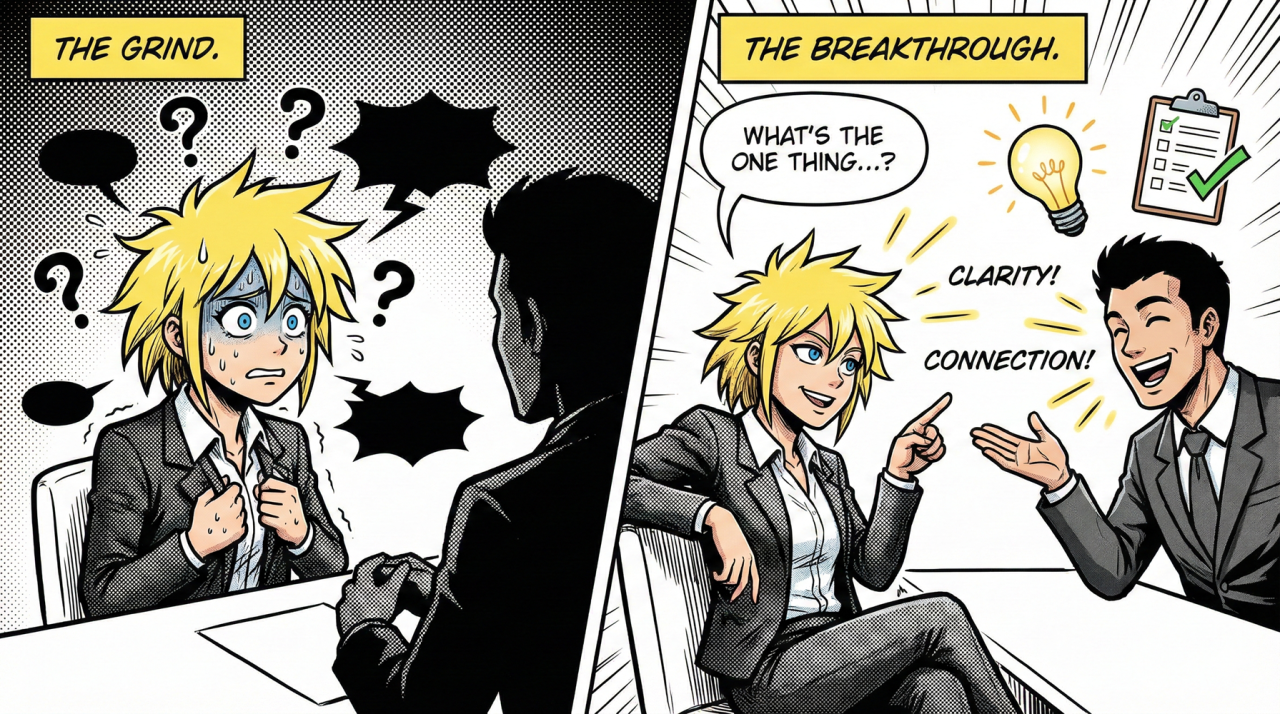
Sarah’s interviews were won in prep, not spotlight sweat. SARB tales, pocket stories, and killer reverse questions...all give you the confidence to go into an interview as a consultant who can fix their problem.
If you still feel like you are 'auditioning' during interviews, take this actionable step:
Get your phone out and record yourself answering "Tell me about yourself" with your 'pocket' story or elevator pitch. Then watch it back with brutal honesty. Tweak the phrasing, remove the 'umms', and beef up the benefits. Practice until it feels natural.
Career storytelling turned Sarah’s interview experience from a police lineup into a business win. She is thriving now, and so can you. You’ve got this.
Categories: : Interview Tips, Job Search Best Practices