Career Pivots Require a "Proof of Work" Identity
 Angela Roberts
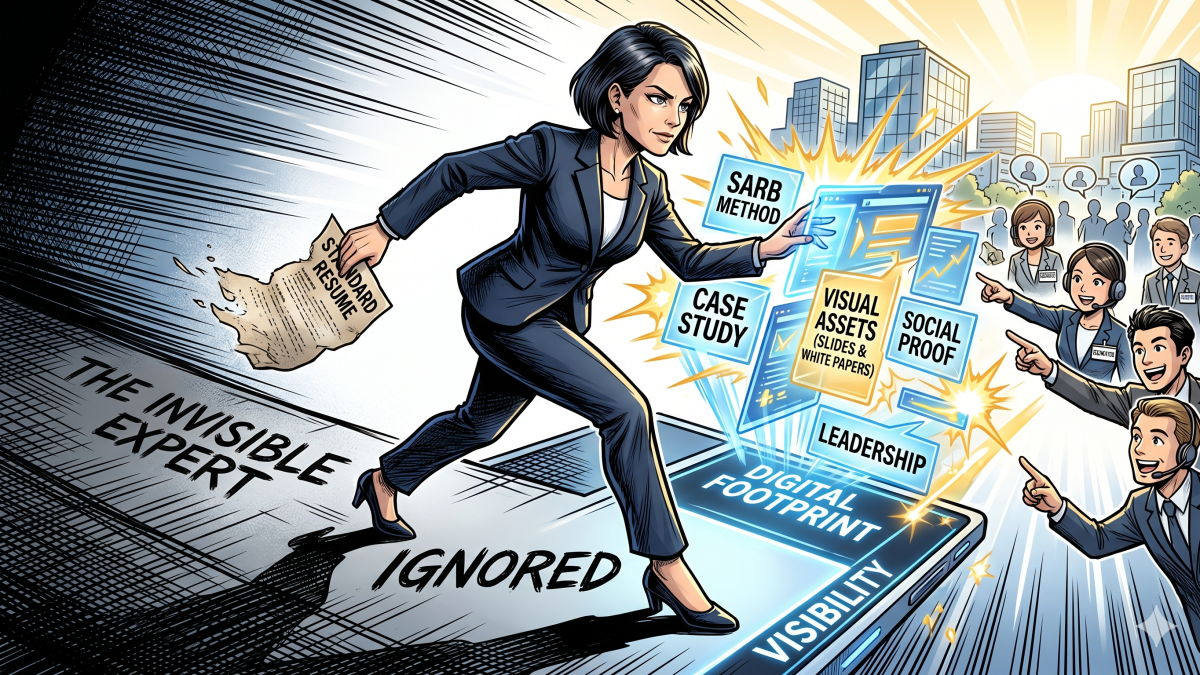
Master the mid-career pivot. Move beyond the resume to a "proof of work" identity that bots and recruiters can’t ignore.
Beyond the Bullet Point: How to Build a "Proof of Work" Identity for Your Next Career Pivot
If you are a mid-career professional, you have likely been told that your resume is your golden ticket. But in today's market, a standard text-based resume is often just a ticket to an automated "rejection" email.
Whether you are looking to pivot industries or level up into the C-suite, the "Invisible Expert" trap is real. You have the experience, but on paper, you look like everyone else. To stand out to both the AI-driven bots and the human hiring managers, you need to shift from a Resume Mindset to a Proof of Work Mindset.
Here is how to build a digital presence that proves you can solve a company’s specific business problems before you even land the first interview.
1. The SARB Method: Turning Tasks into Business Solutions
Most resumes use the STAR method (Situation, Task, Action, Result). That approach is fine, but it is incomplete. To prove your value, you must use SARB: Situation, Action, Result, and Benefit.
- The Difference: The "Result" is what happened (e.g., "We reduced churn by 10%"). The Benefit is why the company’s bottom line cared (e.g., "This saved the company $2M in annual recurring revenue and allowed us to reallocate marketing spend to new acquisitions").
- The Alignment: You cannot just list random wins. You must look at the job description of the role you want and identify their "pain points." If they need a leader who can scale a team, your SARB examples must highlight the benefit of your previous scaling efforts. You aren't just a "manager"; you are a "solution to their growth bottleneck."
2. Visual Assets: Letting Them See Your Thinking
A text-based resume tells, but a visual asset shows. Mid-career professionals often sit on a goldmine of non-confidential materials that can be repurposed to prove expertise.
- The "De-Identified" Slide Deck: Did you create a strategy for a digital transformation? Remove the sensitive data and company logos, and share the framework. It proves you can think structurally.
- White Papers & Articles: Instead of saying you’re an expert in "Agile Methodology," write a 500-word post on how you adapted Agile for a remote, global team.
- Recorded Engagements: If you’ve spoken at a conference or even led an internal "Lunch and Learn," a 2-minute video clip is more powerful than five paragraphs of text. It validates your communication skills and presence instantly.
3. The Soft Skill Signal: Leveraging the "Voice of Others"
Bots scan for keywords, but humans hire for culture and leadership. Since you can’t easily "prove" mentorship on a resume, you must use Social Proof.
- Strategic Testimonials: Don't just settle for generic LinkedIn recommendations. Reach out to a former direct report and ask: "Could you write a brief note about how my mentorship helped you reach your last promotion?"
- The Leadership Narrative: When you share content or update your profile, talk about the people side of your wins. Highlighting how you navigated a difficult team conflict or mentored a high-potential employee signals "Executive Material" to a recruiter.
Why This Works for the "Bot" and the "Human"
- For the Bot: By aligning your SARB examples and articles with industry-specific business problems, you are naturally hitting the high-value keywords that AI scanners are programmed to find.
- For the Human: When a recruiter clicks from your resume to your LinkedIn or personal site, they don't just see a list of dates. They see a living, breathing expert who understands business benefits and has a track record of visible leadership.
The Bottom Line
Your career pivot isn't just about changing your title; it’s about changing how you are perceived. Stop asking recruiters to "trust" your resume. Start giving them the "Proof of Work" that makes hiring you the most logical, low-risk decision they’ll make all year.
Categories: : Job Search Best Practices, Personal Branding, Resume